
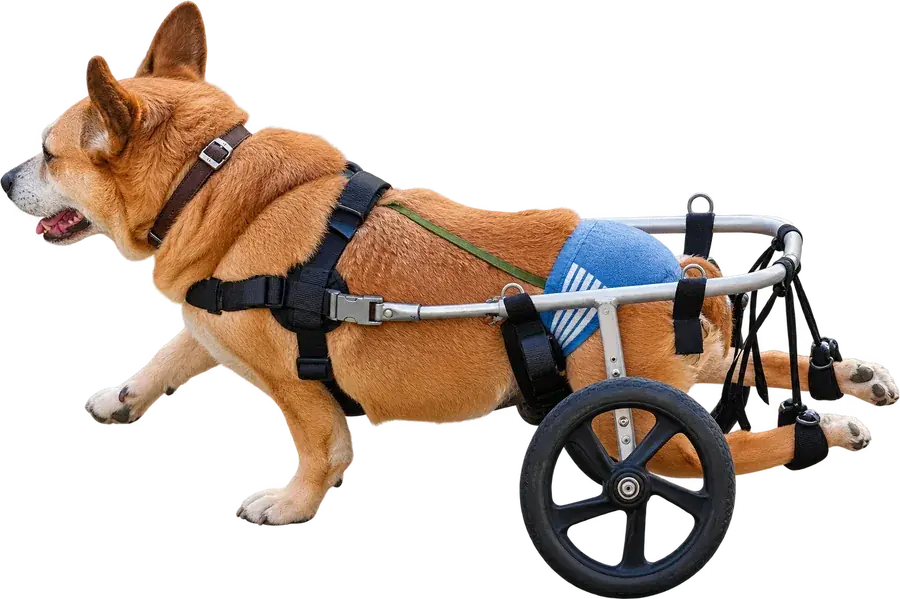
Treatment is always led by a vet. This guide helps you find your way; it does not replace an examination.
When a wheelchair helps
A wheelchair does not give a dog its legs back. It gives back walks, sniffing through the grass, meeting dog friends and the feeling of going where it wants. It makes most sense when:
- the dog is permanently paralysed in the hind legs or they are very weak,
- it has a progressive condition in which leg strength is fading,
- it has lost a limb and is overloading the others,
- a physiotherapist recommends a wheelchair as a rehabilitation aid.
When it is better to wait
Straight after an injury or spinal surgery a wheelchair may not be a good idea. If the dog has a chance of walking again, a wheelchair could discourage it from using its own legs: they bear no load in the cart and the dog has no reason to try. The right time is therefore decided by the treating vet or veterinary physiotherapist, not by an online shop.
Types of wheelchair
Rear (two-wheel) wheelchair
The most common type. It supports the back of the body and the dog moves with its front legs. Suitable for paralysis or weakness of the hind legs.
Front wheelchair
For dogs with weak front legs that can still walk on their hind legs.
Four-wheel wheelchair
Supports the whole body. For dogs whose front and hind legs are both weakening, or when a rear wheelchair would put too much load on the front limbs.
Choosing and fitting
A well-fitted wheelchair is barely felt. A badly fitted one rubs the skin, bends the back and overloads the front legs. When choosing, look for:
- A level back. In the wheelchair the dog should stand with its back in a natural line, hindquarters neither up nor down.
- A harness that does not rub. Straps must not cut into the armpits or groin. Soft padding is a necessity, not an extra.
- Somewhere for the legs to go. Paralysed legs sit in stirrups or hang clear of the ground. They must not drag.
- Weight and dimensions. The wheelchair must suit the dog's height and weight. Measure exactly as the maker instructs, ideally with a physiotherapist.
- Made to measure or adjustable. A custom wheelchair fits best; an adjustable one can be altered when the dog gains weight or its condition changes.
A second-hand wheelchair can serve well if it can be adjusted precisely to your dog. One that "almost fits" does more harm than good.
The first days
- Start short: a few minutes somewhere familiar, with treats and praise.
- Lengthen the time gradually, according to how tired the dog gets.
- Never leave a dog unattended in a wheelchair. In most of them it cannot lie down or rest.
- A wheelchair is not for stairs or steep slopes.
- Check the skin under the straps after every use.
Frequently asked questions
How much does a dog wheelchair cost?
Prices vary widely with the size of the dog, the type of wheelchair and whether it is made to measure. Compare current price lists from several makers and budget for spare parts and adjustments as the dog's condition changes.
Can a dog urinate and defecate in a wheelchair?
In a properly built and fitted rear wheelchair, yes. Check this when choosing; the frame must not get in the way.
How long can a dog stay in a wheelchair?
A few minutes at first, gradually longer. A dog in a wheelchair cannot settle to rest, so do not leave it unattended. A physiotherapist will recommend a routine.
Will my dog struggle to get used to it?
Most dogs adapt surprisingly fast, often within days. Short sessions, treats and a calm setting help. If the dog is frightened or something is pressing, check the fit.
Will HEMI help me choose a wheelchair?
Write to us. We will tell you what to look for and, where we can, help find a solution.